
This post is a tribute to a flower which grows in slime ponds but is unaffected by it, whose delicate beauty has been an enduring symbol of purity for thousands of years. I am talking about the lotus, a flower that originated in India but has been immortalized in the arts of many cultures around the world. I will focus on the lotus imagery imagined in art, design, and architecture.
THE LOTUS IN ART


The ancient Caves at Ajanta are one of the most visited sights in India. Dating to between 200 BCE and 650 CE, they were cut into the face of a mountain, forming a horseshoe shape around a river. There are a total of 30 caves, each dedicated to the life of the Buddha. Shown here is a mural in Cave 1 depicting the Avalokitesvara, the earthly manifestation of the eternal Buddha. Originally a masculine form, Avalokitesvara is also known as the feminine Guanyin in China, and Kuan Yin in Japan. In this mural, the deity is depicted in a characteristic delicate and elegant style. He is adorned with jewelry and on his head sits a majestic crown. His eyes are lowered in a meditative state, his serene pose setting the tone and mood of the cave shrine. In his right hand, he holds a lotus blossom, which represents his spiritual awakening.

Cast in copper alloy and richly gilded, this finely wrought figure of Avalokiteshvara, the early manifestation of the eternal Buddha, is depicted standing in a sensuous pose. The deity has four arms and inlaid jewelry. His central pair of hands hold the stems of lotuses.


This large bronze image of the Buddha is attributed to the lost Khasa Malla kingdom of Western Tibet and Western Nepal that flourished in the 13th century. It was evidently produced by artists in their prime, who produced a work which displays the highest quality of modeling, casting, chasing, and gilding. The Buddha is depicted with fleshy checks, heavy-lidded eyes, and plump lips that are integral to the Himalayan idea of beauty. He sits on a double-lotus band with petals incised with an eyelash motif.


This large bowl is finely worked in repoussé with three rows of overlapping lotus petals, each gilded and exquisitely chased with a pair of birds in flight against a background of leafy foliate, The center of the interior is also chased with a large medallion depicting eight birds in flight against a background of leafy foliate sprays as they encircle a ribbon tied in four loops with trailing ends. This bowl was auctioned in 2019 by Christie’s, New York where it realized US$3.5 million.

In the Song dynasty, warming bowls and ewers are paired wine vessels for daily use. The rim of this elegant warming bowl is in the form of a ten-petal lotus flower. Below it, run deep curving walls in accordance with the contours of the flower-shaped rim. Similar-shaped vessels were also produced in Korea where they are known as Goryeo celadon.

This thousand-year old washer is thinly potted with scalloped sides rising like petals of a lotus in a glaze of sea-tone tone. The delicate refinement of the object belies the political turbulence of this period in China’s history.

This Chinese fan painting depicts a single lotus bloom. It is the oldest lotus painting in the prestigious Palace Museum in Beijing. Wu Bin, the artist, was educated as a literati and skilled as a painter. He was a devout follower of Buddhism who lived and worked in a Buddhist temple in Nanjing until 1610 when he moved to Beijing, where the imperial court assigned him the status of a court painter.

This painting is part of an eight-painting album called “Lotus” at the Freer collection, Smithsonian Institute in the US. It showcases the unique ink-wash style of Bada Shanren, an enigmatic Chinese monk-artist of the 17th century. The work exemplifies the artist’s fondness for tissue-like wash textures and compositions with negative space, which is well suited to the lotus blossom imagery which it depicts.

This imperial porcelain bowl with a ruby-red ground is painted on the exterior with enamels of rich, vibrant tones depicting a lotus pond with large lotus blooms in yellow, pink, blue and greenish white on slender stalks bearing broad lotus leaves. The blooms are interspersed with smaller buds and water reeds in blue, all reserved against a dazzling red ground.

Zhang Dai-chien was one of the best-known and most prodigious Chinese artists of the twentieth century. Originally known as a guohua (traditionalist) painter, by the 1960s he was also renowned as a modern impressionist and expressionist painter, having met Picasso in 1956 and likely influenced by him and other European artists of the time.

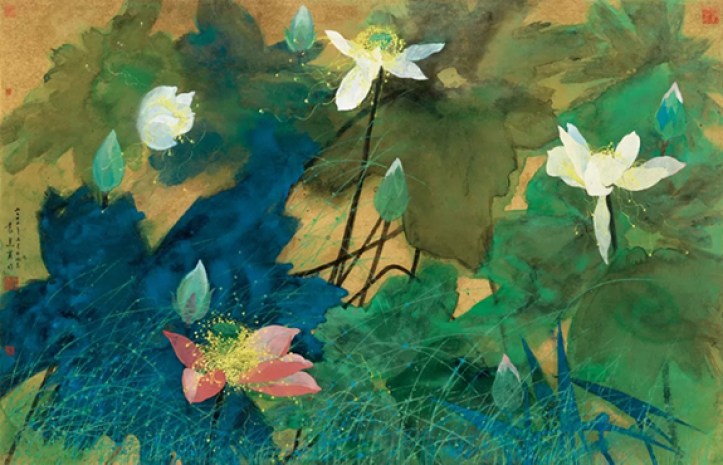
Yuan Yunfu was a former art professor at Beijing’s Tsinghua University.He was also one of the founding fathers of Chinese contemporary public art and a prominent figure in China’s decorative arts scene.

The Impressionist painter, Claude Monet (1840–1926) spent hours seated in Zen-like meditation in his water garden at Giverny, France, which was bursting with hybridized water lilies — created to mimic the pink hues of the Japanese lotus. To Monet, the water lilies were symbolic of peace much like the lotus is a symbol of purity.
And now, a lovely contemporary work by the Bali artist who goes by one name, Putawan in a piece titled, ‘Blue Lotus.’

THE LOTUS IN ARCHITECTURE

The Bahai House of Worship in Delhi, India, popularly known as the Lotus Temple due to its flowerlike shape, is a prominent attraction in Delhi. It was completed in 1986 and serves as the Mother Temple of the Indian subcontinent. Standing at 40m high, the temple gives the impression of a half-open lotus flower, afloat and surrounded by its leaves.
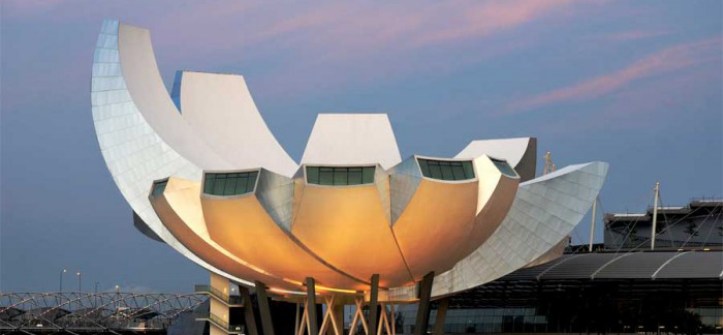
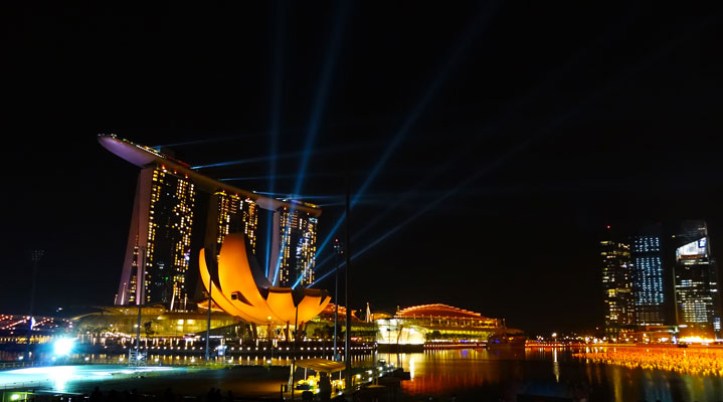
The lotus is clearly the inspiration for this futuristic-looking museum designed by the renowned architect, Moshe Safdie. The base of museum in buried deep into the earth and surrounded by water, above which floats a lotus-like flower composed of ten “petals” of different heights, each having a skylight that allows sun light to penetrate the base and illuminate its galleries.


Melborune-based architecture firm Studio505 designed the Lotus Building in Wujin city, China to resemble a lotus flower with petals that rise dramatically rise out of an artificial lake. The building houses part of the city’s planning bureau, as well as exhibition halls and meeting rooms.
THE LOTUS IN DESIGN


It took 186 hours for Cartier’s artisans to handcraft this brooch, which features a rough aventurine that opens up to reveal a precious pistil, surrounded by curving petals that seem so fluid as to appear quivering under the effect of a gentle breeze.


The fleeting glory of the lotus flower in full bloom is expressed in pear-shape, marquis-cut diamond necklace set in white gold.

Inspired by the dappled colors of lotus pads and buds at dusk, this ring is a mix of rough and polished white and colored diamonds in a white, yellow and rose gold setting. The central diamond weights 4.01 carats. The total carat weight is 10.3.

The lotus chair, designed by Miller Yee-Fong, circa 1968, is noted for marrying the modern form with the rustic material of wicker to create a piece of furniture that is both organic and sculptural. The design takes a leaf from the petals of the lotus blossom, which no doubt attests to Fong’s Chinese roots. The iconic chair is currently in the collections of major US museums such as the Museum of Modern Art in New York, and the Los Angeles County Museum of Art (LACMA) in California.